
Replacement Ultrasound Probes: Buying One That Works on Your System
A probe that plugs in is not always a probe that works. The four kinds of replacement probe you will be offered, the five checks that decide whether one will run on your system, what the quotation must state, and how to test it before you rely on it.
Four kinds of replacement probe
When a probe fails beyond repair, or you add an exam that needs a new one, you will usually be offered one of four things. They differ in who made the probe, who stands behind it and how much is known about its history. AIUM warns that defective, poorly remanufactured or poorly repaired probes can lead to a wrong or missed diagnosis, so the cheapest option is not automatically the economical one.
| Option | What it is | Ask for |
|---|---|---|
| New, from the system maker | A new probe of a model listed for your system, supplied through the maker’s authorised channel | The part number for your system model, the warranty and the lead time |
| Maker-refurbished or exchange | A used probe tested and reworked by the maker, sometimes swapped for your failed one | What was replaced, the test results, and whether the warranty matches a new probe |
| Third-party refurbished | An original probe rebuilt by an independent repair company | Where it came from, the element and leakage test report, the parts used and the repair warranty |
| Third-party compatible | A probe made by another company to run on your system | Evidence it was tested on your system model and software version, and its own registration |
Read next Repair or replace: probe faults and repair options
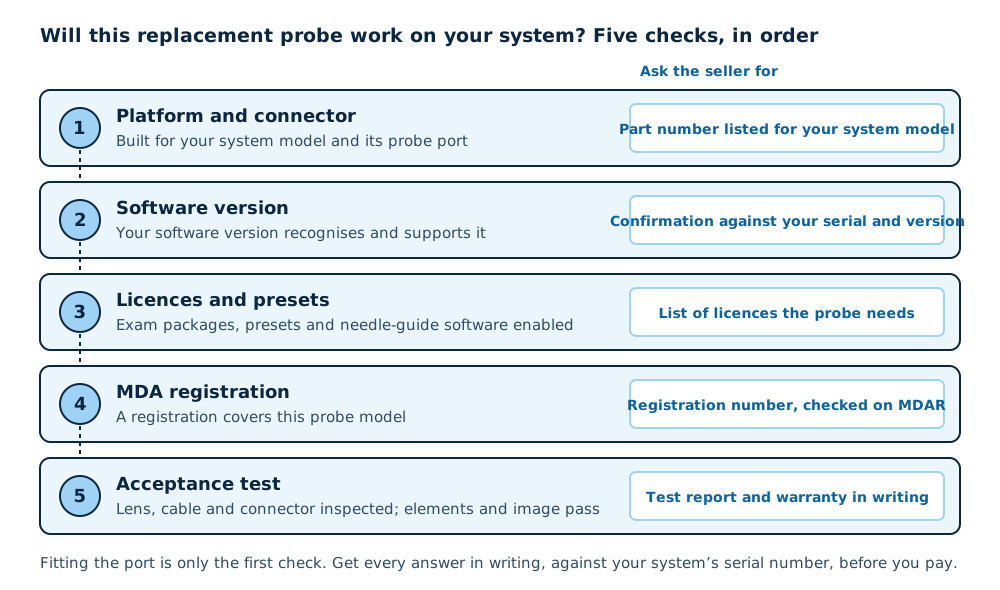
Will it work on my system? Five checks
1. Platform and connector
Probes are built for one platform family and its probe port. A probe from another model of the same brand may not fit, or may fit and not be supported.
2. Software version
The system identifies the probe when it is connected and needs presets and settings for it. Some probes need a newer software version than the one your system runs, so quote the version shown on your system’s information screen.
3. Licences and presets
A phased-array probe is of little use without the cardiac measurement package, and a biopsy guide needs needle-guide software. Ask which licences the probe depends on and whether your system already has them.
4. Registration
The probe model must be covered by an MDA registration and sold by a licensed establishment — see below.
5. Acceptance test
Inspect and test the probe before you rely on it, and keep the report. A probe that fails should go back within the return window.
MDA registration for a probe
MDA guidance on the definition of a medical device says an accessory intended by its maker for use with a parent device is classified as a medical device in its own right. Under the Medical Device Act 2012 (Act 737), a medical device must be registered before it is imported or placed on the Malaysian market, and the company importing or selling it must hold an MDA establishment licence.
- Ask which registration covers the probe model. It may be listed under the system’s registration or registered on its own.
- Check the number on the Malaysia Medical Device Register and make sure the probe model appears on it.
- For a third-party compatible probe, ask for the registration that covers that probe — not the registration of the system it plugs into.
- A probe shipped straight from an overseas website still has to be a registered device brought in by a licensed establishment. Ask who the importer is before you pay.
Read next How to check MDA registrationHow to choose an ultrasound supplier
What the quotation must state
- The exact probe model and part number, and whether it is new, maker-refurbished, third-party refurbished or third-party compatible.
- Your system model, serial number and software version, with a statement that the probe is supported on it.
- Any software upgrade or licence the probe needs, and who installs it.
- The serial number of the probe being supplied and, for a used probe, its test report.
- The warranty period, what it covers and what voids it. Drops, cable damage and unapproved disinfectants are the usual exclusions.
- The return window if the probe fails acceptance testing, and who pays the courier both ways.
- The lead time, and whether a loaner probe is available until it arrives.
- The MDA registration number that covers the probe.
Read next Probe cover in a service contractWhat a full ultrasound quotation should list
Checks when the probe arrives
Test the new probe before you send your old one away for exchange or scrap. AIUM recommends that users check their probes regularly for element dropout, and quality control matters most for a probe whose history you do not know.
- Match the serial number and part number on the probe to the quotation and the delivery note.
- Inspect the lens, housing, strain relief, cable and connector pins for cracks, swelling, cuts or bent pins.
- Connect it and confirm the system recognises the model and loads the right presets.
- Run the system’s probe self-test if it has one, or scan a uniform area of a phantom (or a gel pad on your skin) and look for dark vertical lines that mark dead elements.
- Scan your most common exam with the new probe and, if you still have it, the old one, and keep screenshots as a baseline.
- Check that your disinfection method is on the probe maker’s compatibility list for this model before the first patient.
Read next How a probe is testedPhantoms for probe and image checks
Related guides
Ultrasound Machine supply near you
Written quotes for clinics across Malaysia, handled from Batu Caves, Kota Kinabalu and Kuching.
Sources and further reading
- AIUM — Official statement: Transducer testing and repair
- Medical Device Authority — Guidance document: Definition of medical device (Act 737, section 2)
- Medical Device Authority — Malaysia Medical Device Register, public search
- Medical Device Authority — Establishment licence information (section 15, Act 737)
- Oglat AA. Performance evaluation of an ultrasonic imaging system using tissue-mimicking phantoms for quality assurance. Biomimetics 2022;7:130
Frequently asked questions
How much does a replacement ultrasound probe cost?
Can I use a probe from another brand on my ultrasound machine?
Is a refurbished ultrasound probe a good idea?
Does a replacement probe need MDA registration?
How do I test a new ultrasound probe?
Should I repair my probe or buy a replacement?
Get a written quotation
Tell us your clinic or lab type, daily workload and location. We match suitable models and send a written quotation that states who handles delivery, installation and training, and what each costs.
010-905 2891 · Mon–Sat, 9:00 am – 6:00 pm